



![Wired Remote Controller for Waykar AFW Crawlspace Dehumidifiers [XSB-A01]](http://www.waykar.com/cdn/shop/files/2_321b3be6-28e1-41b8-8d55-cc947f4bd452.jpg?v=1751005864&width=150)

Different crawl spaces have varying needs, depending on the size and humidity level. Earlier, our post answered whether or not you need a crawl space dehumidifier.
Now, we will explore what unit is best for you. After all, investing in the wrong dehumidifier will rob you of both peace and money.
But choosing the right crawl space dehumidifier is not an obvious exercise. For example, if you plan to run the device continuously, you should consider its energy efficiency. Also, you may need the drainage and remote access options for more convenience.
Key Considerations When Choosing the Right Crawl Space Dehumidifier
There are some selection criteria for a crawl space dehumidifier that you should not miss. They include:
-
Available Crawl Space
-
Dehumidifier Capacity
-
Humidity Levels
-
Drainage Options
-
Service Access and Remote Control Options
-
Ducting Need
-
Energy Efficiency
-
Compressor Warranty and Service Support
Below, we have explained these points and how they affect your crawl space dehumidifier.
Check the Available Space — Especially the Height
Will the physical dimension (especially the height) of the dehumidifier fit into the crawl space? Crawl spaces are often compact. So a taller dehumidifier will struggle to get in. And you do not want it laying awkwardly in the crawl space.
Another potential challenge to anticipate is the access door or entry point to the crawl space. Is it wide and high enough for the dehumidifier? Of course, you can revert to our advanced units with the ducting feature when drying up extremely narrow spaces. We will later discuss this feature in detail.
However, you may be better off getting a compact unit like the 70 Pint Energy Star Crawl Space Dehumidifier. It measures just a little over 13 inches high. So it will get into low-clearance areas, while still allowing space for airflow.
While height consideration is crucial, you should note that it is distinct from the unit’s capacity. They both decide how your unit functions.

Match the Dehumidifier Capacity to Your Crawl Space
You may have noticed that dehumidifiers are rated in pints. This refers to the volume of water that the unit can extract under certain conditions in a 24-hour period. But a larger pint size isn’t always better. When determining the dehumidifier capacity that is suited for you, it’s helpful to consider the crawl space size and moisture conditions.
So, imagine that you are dealing with a very damp crawl space that is under 1,000 sq. ft. A 70 pint unit would suffice. Bigger spaces dealing with standing moisture may demand higher capacities like the 125 Pint Crawl Space Dehumidifier. Massive crawl spaces can opt for the 158-Pint or the commercial 216-Pint unit.
Humidity level can be a tricky subject, but we will discuss this next and how it should influence your dehumidifier choice.

Check the Humidity Level
Relative humidity (RH) is one important metric for determining humidity levels. It measures the water content in the air compared to the maximum amount the air can hold at that temperature. So it is expressed as a percentage.
Hence, a 100% RH represents a fully saturated air. In contrast, 0% RH means the air is fully dry. Both of these extremes may be undesirable. A maintained relative humidity of 45% to 55% is the sweet spot for most crawl spaces.
So you may want a unit with an automatic humidity control. So the device only resumes operation when the relative humidity crosses a fixed level. Slowly, the musty odor and dampness caused by humidity begins to vanish.
Note that ground water evaporation, ventilation, and condensation all impact the relative humidity of your crawl space. While there might be little you can do about these, you want to address any underlying issue in case of a water leak or flood.

Consider the Drainage Options
The crawl space dehumidifier will likely operate for a long time with minimal supervision. It will collect huge volumes of water in the process. Hence, many users are concerned about draining the extracted water so the machine never has to cease operation due to a full tank.
As a result, many commercial dehumidifiers have one or both of these drain types:
-
Gravity drain
-
Pump drain
These two operate differently, but they help to drain water content from the inside reservoir. The better drain choice will depend on your setup.
Gravity drain allows water flow down the attached hose. However, for this to work, the drain must be positioned lower than the dehumidifier's water outlet or hose. This method is simple and reliable, but may be impractical in setups where the drain is higher placed.
The pump drain can push water up a slope using the unit’s built-in pump. The device must be plugged to electricity to operate the pump. Also, most fitted pumps have a vertical height limit (up to 15 feet) for expelling water.
Homeowners must pay attention to drainage so that expelled water does not spill back, creating an endless circle of dehumidification and humidification. When possible, you want to discharge the water outdoors, away from the building’s foundation.
Supposing your unit has no built-in pump, and gravity drain is impractical in your location, you can use an external condensate pump. Simply channel the condensed water to the pump through a hose. With a different hose, you can direct the collected water to your desired outlet.
Consider Service Access and Remote Control
Compact crawl spaces are difficult to reach. Yet, access can allow you service and control the dehumidifier. So when choosing a dehumidifier for an inaccessible or hard-to-reach area, remember that a model with remote control support is convenient. This will allow you to operate the unit from a suitable spot.
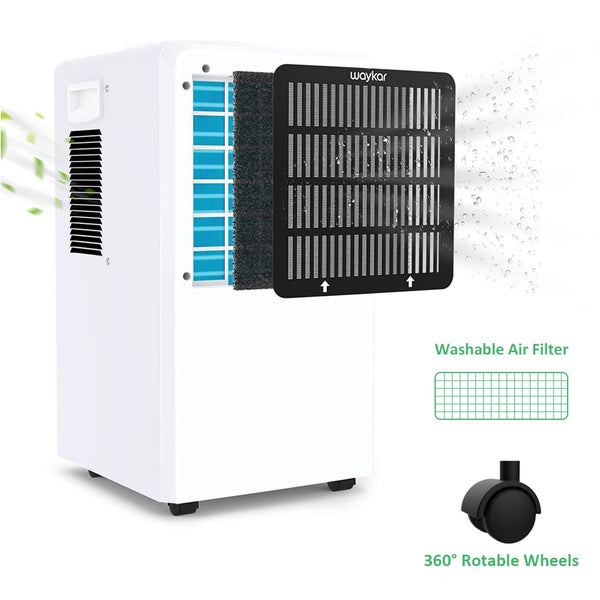
Also, you want one with accessible filters. So that a non-technical user can occasionally detach the filter for cleaning and maintenance.

Decide Whether You Need Ducting
Instead of the normal open-air circulation for your dehumidifier, you can choose to focus on particularly humid areas in the space without necessarily exposing the unit to harsh conditions. You can do this by ducting.
Ducting allows you to connect inlet and outlet ducts to the device. So the machine can be in one place, while it draws air from another place and sends treated air elsewhere. Some homeowners use this feature to dehumidify inaccessible areas within the crawl space.
Ducting is useful for:
-
Protecting the unit from extremely humid or harsh conditions.
-
Focusing on moisture-prone areas in the crawl space.
-
Improving air distribution in a larger or divided crawl space.
-
Integrating the dehumidifier with an existing HVAC equipment.
Homeowners must consider their crawl space layout and ventilation needs when deciding whether or not to use air ducts.
Consider Energy Efficiency
A crawl space dehumidifier may operate for extended periods, especially during humid seasons such as the winter. This can rack up electricity bills. Even off-grid solar setups must keep up with the additional load from the device.
In the long run, an energy-efficient model will save you money. It’s why Waykar crawl space dehumidifiers are Energy Star certified. These units can use almost half the energy of non-certified units.
Also, the device will pause operation once it achieves target humidity levels and resume back automatically when the humidity rises past a set level. This feature will save you energy.
However, remember that operating conditions directly affect energy consumption. Hence, high humid areas will take longer and cost more to dehumidify.
Remember that choosing the right capacity of energy-efficient dehumidifiers will help you manage the electrical load and long-term operating costs. An oversized will likely cost you more in terms of bills.
Also note that some dehumidifiers may be cheaper upfront but can incur a higher cost of ownership in the course usage. Hence, you should factor this overall cost when making a choice.
Check Compressor Warranty and Service Support
A dehumidifier is one crucial appliance that must be reliable. It’s why you should only shop with manufacturers offering a warranty and after-sales support. You can confirm the warranty length for the compressor and overall product.
Also, it is useful to know whether replacement parts are available. So you’re not forced to replace the entire unit when just swapping parts would suffice. Since setting up a dehumidifier can be a bit technical, reliable customer support and service options are more than just nice-to-haves.

Conclusion
There are a handful of factors to consider when choosing the right crawl space dehumidifier. So, simply choosing the highest capacity dehumidifier will be a disservice to you. Instead, a good dehumidifier should fit your crawl space and match its humidity conditions.
Drainage and ducting options can help solve certain setup challenges. Also, it helps for the unit to be accessible for everyday operation and routine maintenance.
Finally, remember that an energy-efficient unit will minimize the cost implication of prolonged operation. And for peace of mind, opt for makers offering a reliable warranty plus customer support.
No single factor is the ultimate. You should evaluate these factors as they fit your specific needs. This will allow you to choose the right dehumidifier for your crawl space.